
Cost Segregation Study Example for Commercial Real Estate: A Step-by-Step Breakdown
Many investors understand the concept of cost segregation but struggle to see how it works in practice. A clear cost segregation study example shows exactly how a property is analyzed, broken down into shorter-life asset categories, and reclassified for depreciation to accelerate deductions, increase early tax savings, and improve cash flow.
For commercial or residential income-producing property owners with basis above roughly $300,000—and for CPA firms and tax advisors that need audit-ready studies without adding internal capacity—this makes the strategy easier to evaluate in real terms. A cost segregation study follows a structured, engineering-based process that identifies building components and assigns them to shorter recovery periods, as explained in this overview of what a cost segregation study is and how it works.
This article walks through that process step by step, from property data collection, engineering review, asset classification, and cost allocation to the final report used for IRS compliance. It also shows what drives the tax savings, how results can vary by property, and when a study makes sense for your investment.
What Does a Cost Segregation Study Example Look Like?
A cost segregation study begins by separating a property into asset categories rather than treating it as a single depreciable structure.
Typical Property Scenario
Consider a commercial property with a purchase price of $2,500,000. If $500,000 is allocated to land, the remaining $2,000,000 represents the depreciable building value.
In this example, the property is assumed to be an income-producing investment property, since only income-producing property qualifies for cost segregation. Under standard depreciation, that value would be recovered over 39 years for commercial properties (or 27.5 years for residential properties).
Reclassification Breakdown
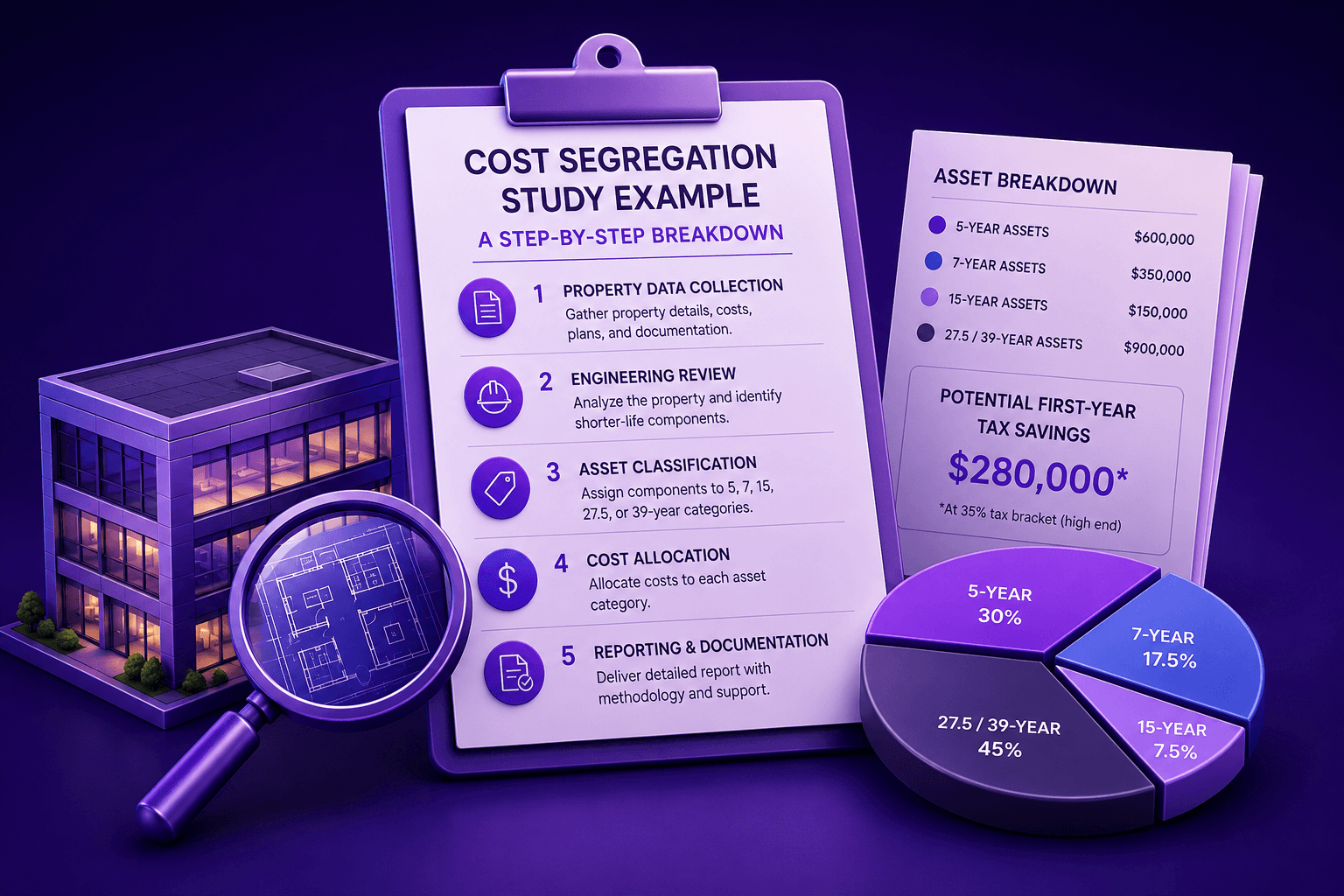
In a typical study, 30 percent to 40 percent of the building value may be reclassified into shorter-life assets. In this example, roughly $400,000 to $800,000 becomes eligible for accelerated depreciation. In a sample building, about $300,000 may qualify for bonus depreciation once assets are reclassified.
How a Cost Segregation Study Works Step by Step
The value of cost segregation comes from a structured process that combines engineering analysis with tax strategy. Many studies begin with a feasibility analysis to confirm that the expected savings justify the work, followed by a property inspection.
Step 1: Property Data Collection
The process begins with gathering detailed property information, including purchase documentation, construction costs, design plans, and property records. Accurate inputs are critical because they drive the entire analysis.
Step 2: Engineering Review and Site Analysis
A property analysis identifies components that qualify for shorter recovery periods, as outlined in this comparison of technology-enabled vs. traditional cost segregation studies. A physical inspection helps identify assets such as plumbing fixtures and other shorter-life components. The review should be a thorough analysis performed by qualified professionals.
Step 3: Asset Classification
Each component is assigned to a depreciation category, with certain assets moved into 5, 7, or 15-year classes for depreciation purposes. Eligible assets may also qualify for bonus depreciation, allowing an immediate write-off instead of multi-year depreciation when placed in service after September 27, 2017. Remaining structural elements continue under 27.5 or 39-year schedules, following IRS guidelines.
Step 4: Cost Allocation
The study allocates portions of the property's cost basis to each identified asset category rather than the entire building. This determines how much of the property qualifies for accelerated depreciation.
Step 5: Reporting and Documentation
The comprehensive report includes a detailed asset breakdown, methodology, and supporting documentation. It supports the tax return and helps document an IRS-approved tax strategy. Proper reporting is essential for IRS compliance and audit defensibility, and this documentation enhances tax compliance by providing an IRS-defensible methodology.
How Much Tax Savings Can This Generate?
The financial impact becomes clear once accelerated depreciation is applied. For example, a $1 million apartment building can generate about $142,000 in annual depreciation through reclassification.
Using the example above, if $400,000 to $800,000 is reclassified into shorter-life assets, a significant portion may qualify for accelerated depreciation in year one.
At the higher end, if $800,000 qualifies and the investor is in a 35 percent tax bracket, tax savings could reach approximately $280,000 in the first year. In some scenarios, a $1 million property can deliver up to $72,634 in potential tax savings.
Earlier deductions increase immediate cash flow and improve overall investment performance.
Cost Segregation vs Standard Depreciation
Without cost segregation, the $2,000,000 building value would be depreciated evenly over 39 years, resulting in smaller annual depreciation deductions.
With cost segregation, a significant portion of that value is recognized earlier. These accelerated depreciation deductions shift more of the depreciation schedule into the early years instead of spreading it evenly over the full recovery period. While total depreciation remains the same over time, the timing shifts forward.
That shift is what creates meaningful financial impact, and it can significantly reduce current tax liability because the deductions arrive sooner.
What Factors Influence Results?
Results vary, but several key factors consistently impact outcomes.
Property Type
Different property types produce different results, and properties with higher-value interior finishes and specialized systems typically generate higher reclassification percentages. Buildings with less value allocated to land also tend to produce stronger results across multiple property types, including multifamily properties and rental property assets. Hospitality, medical, and retail properties are common examples. Land improvements such as landscaping and specialized lighting may also qualify for shorter recovery periods.
Construction Complexity
More complex buildings contain more identifiable components, creating more opportunities to identify property related costs and classify personal property separately from real property for accelerated depreciation.
Timing of the Study
Timing affects both eligibility for accelerated depreciation and when to conduct a cost segregation study. The best time is usually after property acquisition or during renovation, although you can conduct a cost segregation any time after acquisition. Look-back studies can also be used on previously owned properties, including additional properties acquired since 1987, to identify components for retroactive deductions.
Quality of the Analysis
An engineering-based cost segregation analysis ensures accurate classification, maximizes deductions, and supports IRS compliance. Following comprehensive cost segregation study standards strengthens the cost segregation process and supports the final cost segregation work.
Is This Cost Segregation Study Example Typical?
This example reflects a common range, but actual results depend on the property. Studies are often most effective for property owners with buildings purchased, constructed, or renovated for over $500,000, and the economics are especially strong for properties worth over $750,000.
Most studies identify 20 percent to 40 percent of building value as short-life assets. Higher percentages are possible for properties with extensive interior improvements, while simpler buildings may fall on the lower end.
Understanding these ranges helps set realistic expectations before starting a study.
When Does a Cost Segregation Study Make Sense?
A cost segregation study is most effective when it aligns with the property, the investor’s tax situation, the expected holding period, and whether the asset is used for business purposes, similar to scenarios outlined in the IRS audit guide to cost segregation
It is typically worth considering when property value exceeds $300,000, taxable income is sufficient to benefit from deductions, and the holding period supports depreciation. To determine whether this strategy will maximize tax benefits, real estate owners should work with a tax advisor or tax professional.
What to Expect From a Professional Cost Segregation Study
A professional study should include detailed asset classification, a clear methodology, and documentation that supports IRS compliance. It should also show which assets qualify for bonus depreciation under the jobs act changes tied to the tax cuts. The Tax Cuts and Jobs Act increased bonus depreciation to 100%, but the deduction is 60% in 2024 and drops to 40% in 2025.
Technology-enabled approaches may improve efficiency and consistency, while traditional on-site reviews may provide deeper inspection depending on the property.
Ready to Evaluate Your Own Cost Segregation Study?
A cost segregation study example shows how depreciation can be accelerated and how tax savings are generated in practice.
If you are acquiring a property, holding one without a study, or planning for higher taxable income, a detailed analysis can help quantify savings and guide decision-making.
SegTax combines engineering expertise with strategic tax insight to deliver accurate, audit-ready studies that help real estate investors maximize depreciation and improve cash flow.
FAQ
What is a cost segregation study example?
It shows how a property is broken into shorter-life asset categories to accelerate depreciation and increase early tax deductions.
How accurate are these examples?
They reflect typical ranges, but results vary based on property type, value, and complexity.
How long does a cost segregation study take?
Most studies are completed within a few weeks, depending on property size and documentation.
Can cost segregation be used for residential properties?
Yes. Many residential rental properties, especially short-term rentals, may qualify.
Is a cost segregation study worth it?
In many cases, first-year tax savings exceed the cost of the study.