
Cost Segregation Tax Savings: How Much Can You Really Save?
Most investors hear about cost segregation tax savings but struggle to quantify the actual return. The concept sounds compelling, but the real question is simple. How much does it actually put back in your pocket?
The answer depends on property type, purchase price, tax bracket, and timing. When structured correctly, a cost segregation study can generate significant first-year deductions and measurable ROI within a short period.
Understanding the numbers behind the strategy is what separates informed investors from those leaving tax savings on the table.
How Does Cost Segregation Tax Savings Work?
At its core, cost segregation accelerates depreciation by reclassifying building components into shorter recovery periods.
What Gets Reclassified
Instead of depreciating an entire property over 27.5 or 39 years, a cost segregation study identifies components that qualify for shorter recovery periods, typically 5, 7, or 15 years, based on MACRS depreciation system guidelines.
These often include electrical systems tied to equipment, interior finishes like flooring and cabinetry, and land improvements such as parking areas and landscaping. The process relies on an engineering-based analysis to ensure compliance with IRS standards, as explained in this breakdown of technology-enabled vs. traditional cost segregation studies.
Why This Creates Immediate Savings
Accelerated depreciation allows investors to take larger deductions earlier in the ownership period. This reduces taxable income faster and improves short-term cash flow.
The value comes from timing. Deductions taken earlier have a greater financial impact than those spread over decades.
How Much Cost Segregation Tax Savings Can You Expect?
Exact savings vary, but there are consistent benchmarks investors can use to estimate impact.
Typical Reclassification Percentages
Most studies reclassify 20 percent to 40 percent of a property into shorter-life assets. For example, a $2 million property may have $400,000 to $800,000 eligible for accelerated depreciation.
Estimated First-Year Tax Savings
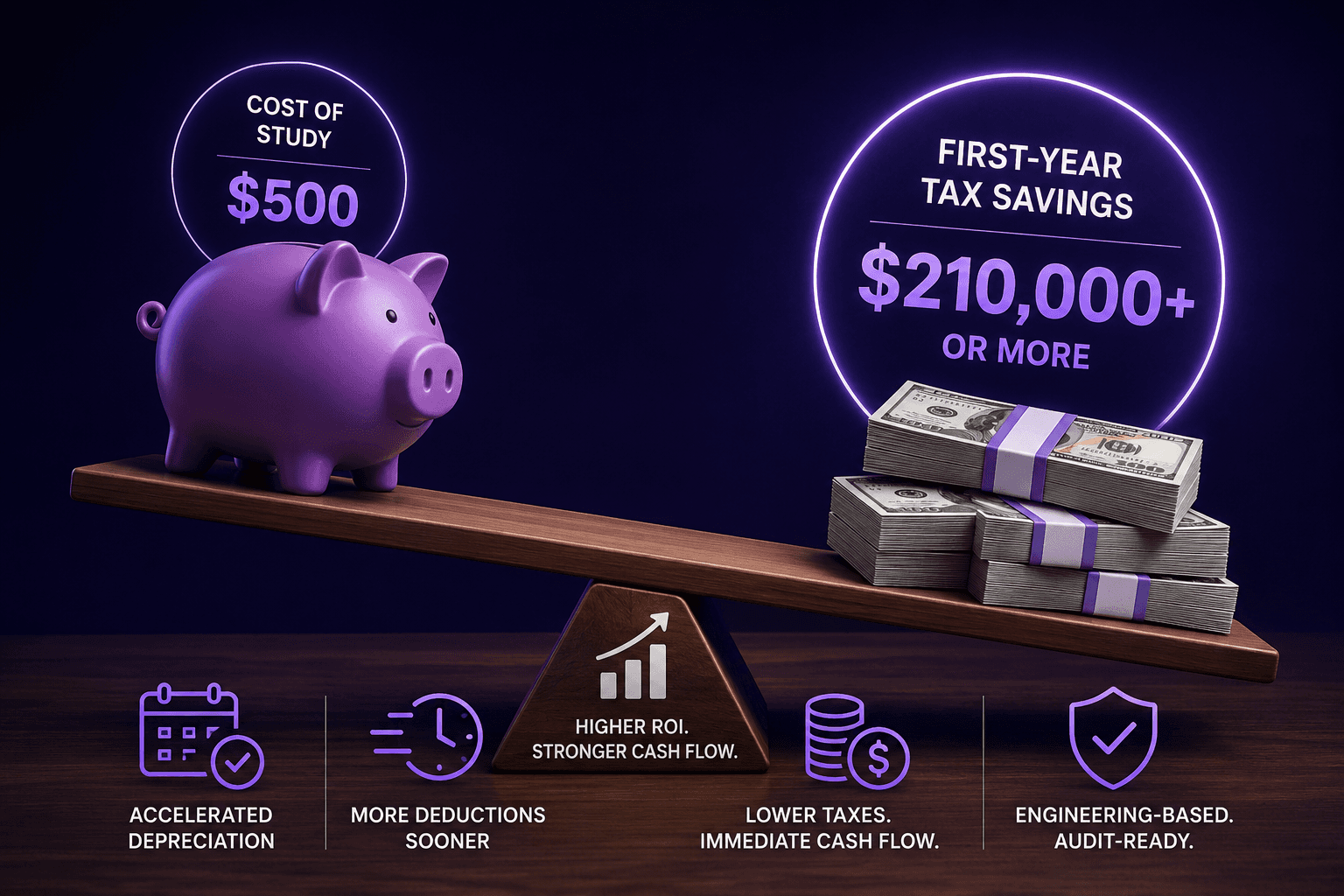
If $600,000 is reclassified and the investor is in a 35 percent tax bracket, the estimated tax savings would be approximately $210,000 in the first year.
This is a direct reduction in tax liability, not a deferred benefit.
Cost Segregation Study Example
A simplified example helps illustrate how the numbers work.
Example Scenario
Consider a property purchased for $3,000,000, with $2,400,000 allocated to the building and $600,000 to land. A cost segregation analysis identifies 30 percent of the building as short-life assets.
This results in $720,000 eligible for accelerated depreciation.
First-Year Tax Savings
Assuming a 37 percent tax rate, the estimated first-year tax savings would be approximately $266,400.
ROI on the Study
If the study costs $500, the return is substantial. In many cases, first-year savings alone exceed the cost of the study by a wide margin.
What Factors Impact Cost Segregation ROI?
Not all properties produce the same results. Several key factors influence total savings.
Property Type
Properties with specialized systems and interior improvements tend to yield higher reclassification percentages. Hotels, medical facilities, and retail spaces are strong examples, as seen in cost segregation for real estate investment trusts.
Purchase Price and Allocation
Higher-value properties typically generate larger deductions. Proper allocation between land and building is critical for accuracy.
Tax Bracket
Your tax rate influences how much you save, but cost segregation can provide meaningful tax benefits regardless of income level. Higher tax brackets may increase the immediate impact, but the strategy remains valuable across a wide range of scenarios.
Timing and Bonus Depreciation
Timing plays a major role. When bonus depreciation is favorable, more savings are realized upfront. Otherwise, benefits are spread over time.
Is Cost Segregation Worth It?
Cost segregation is not universal, but it is often more valuable than investors expect.
When It Makes Sense
It is most effective when property value is significant, taxable income is high, and the holding period allows depreciation benefits to be realized, similar to scenarios outlined in the IRS audit guide to cost segregation.
When It May Be Less Effective
It may be less impactful when taxable income is low, the property will be sold quickly, or depreciation recapture outweighs short-term gains.
Even in these scenarios, proper planning can improve outcomes.
How to Maximize Cost Segregation Tax Savings
Maximizing results requires a strategic approach.
Align deductions with higher-income years to increase impact. Work with a CPA to ensure the study fits within your broader tax strategy and that deductions are fully utilized.
Use an engineering-based study for accuracy and compliance. Plan for the long term, including holding period, exit strategy, and future acquisitions.
A well-structured cost segregation analysis supports both immediate tax savings and long-term investment performance.
What to Expect From a Cost Segregation Study
A professional study should include detailed asset classification, a clear methodology, and documentation that supports IRS compliance.
Quality matters. Poorly prepared studies can reduce benefits or create unnecessary risk. A properly executed study ensures accuracy and defensibility.
Ready to Evaluate Your Cost Segregation ROI?
Cost segregation tax savings are measurable and can significantly impact investment performance. Delaying a study can result in substantial missed deductions.
If you are acquiring a property, planning a purchase, or expecting higher taxable income, evaluating a cost segregation study is a practical next step.
SegTax combines engineering expertise with strategic tax insight to deliver accurate, audit-ready studies that help real estate investors maximize tax savings and improve cash flow.
FAQ
How much can you save with cost segregation?
Savings vary, but many investors see significant first-year tax reductions depending on property value and tax rate.
What is a typical cost segregation example?
Most studies reclassify 20 percent to 40 percent of a property into shorter-life assets, resulting in larger upfront deductions.
How fast does a cost segregation study pay for itself?
In many cases, first-year tax savings exceed the cost of the study.
Is cost segregation only for commercial real estate?
No. Residential rental properties may also qualify, especially higher-value or short-term rentals.
Does accelerated depreciation increase audit risk? A properly documented, engineering-based study that follows IRS guidance is widely accepted and does not inherently increase audit risk.