
How Much Does a Cost Segregation Study Cost in 2026?
Most investors hesitate at the same point. They understand the tax benefits, but want clarity on cost before moving forward.
“How much does a cost segregation study cost” is one of the most common questions among real estate investors. The answer is not fixed, but the range becomes predictable once you understand what drives pricing.
The real decision is not just about cost. It is whether the study produces a return that justifies the investment.
Average Cost of a Cost Segregation Study
Pricing varies based on property size, complexity, and methodology, but there are clear benchmarks.
Advancements in technology have allowed some firms to deliver studies more efficiently, which can improve overall return on investment for clients. However, it is important that the analysis is still grounded in an engineering-based approach to ensure accuracy and defensibility.
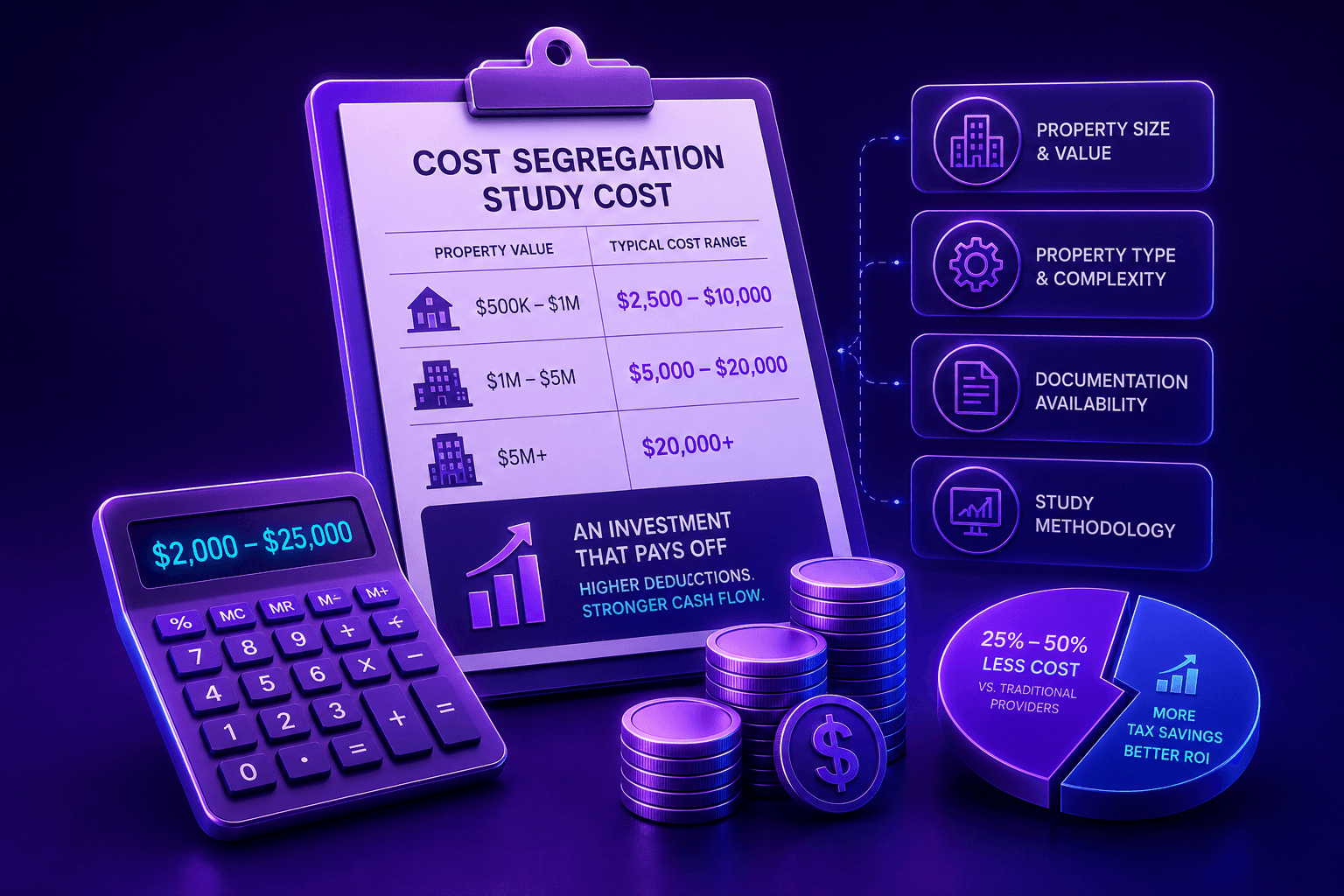
For most properties, a cost segregation study typically ranges from $2,000 to $25,000. Smaller residential or light commercial properties fall on the lower end, while larger or more complex commercial assets trend higher.
A property valued between $500,000 and $1 million may cost $2,500 to $10,000. Properties between $1 million and $5 million often range from $5,000 to $20,000. Larger or specialized properties can exceed that range depending on scope.
What Factors Affect Cost Segregation Study Pricing?
Several variables influence pricing across providers.
Property Size and Value
Larger properties require more detailed analysis and documentation. More square footage and higher asset value increase the complexity of classification and cost allocation.
Property Type and Complexity
Standard properties are easier to analyze, while properties with specialized systems require deeper engineering review. Hospitality, medical, and industrial assets often involve more detailed work.
Documentation Availability
When construction documents, blueprints, and cost records are available, studies can be completed more efficiently. Limited documentation may increase cost due to additional estimation work.
Study Methodology
The approach used by the provider directly impacts pricing. Some firms rely on technology-enabled models, while others perform detailed on-site engineering reviews.
Are Lower-Cost Cost Segregation Studies Worth It?
Lower pricing can be appealing, but it often reflects differences in methodology and depth.
Lower-cost studies may rely more heavily on estimates or standardized models. While this reduces upfront cost, it can limit the amount of depreciation identified or weaken audit defensibility.
Higher-quality studies typically include detailed engineering analysis, more precise classification, and stronger documentation, improving both accuracy and compliance.
How to Evaluate Cost vs ROI
The cost of a study should always be evaluated relative to the tax savings it generates. To better understand how these savings translate into value, review Top 10 Benefits of Cost Segregation for Commercial Real Estate Owners.
Typical ROI
In many cases, first-year tax savings significantly exceed the cost of the study. For example, a $5,000 study that produces $150,000 in accelerated depreciation can generate meaningful tax savings depending on the investor’s tax rate.
The key metric is not cost alone, but cost relative to benefit.
What Drives Higher ROI
Higher returns are typically driven by:
Larger property values
Higher tax brackets
Greater reclassification percentages
Favorable depreciation rules
Working with technology-enabled providers that can deliver more efficient and data-driven analyses
Why Cost Segregation Pricing Varies Between Providers
Not all providers price their services the same way.
Some firms use flat-fee pricing based on property value. Others adjust pricing based on complexity, scope, and documentation requirements.
Technology-enabled firms often provide more consistent pricing, while traditional providers may vary based on their projected hours over the scope of the engagement.
The approach used by the provider directly impacts pricing. For a deeper comparison of methodologies, see Technology-Enabled vs. Traditional On-site Cost Segregation Studies.
When Does a Cost Segregation Study Make Financial Sense?
Cost is only one part of the equation. The more important question is whether the study aligns with your financial situation.
A cost segregation study typically makes sense when property value is high enough to generate meaningful depreciation and when the investor has sufficient taxable income to benefit from deductions.
Holding period also matters. Investors planning to hold a property longer are more likely to benefit from accelerated depreciation.
How to Choose the Right Cost Segregation Provider
Choosing a provider goes beyond comparing pricing.
Evaluate methodology, level of engineering involvement, and documentation quality. A well-prepared study should clearly explain asset classification, include supporting data, and follow IRS guidelines.
Experience with your property type can also improve accuracy and results.
What to Expect From Cost Segregation Services
A professional study should include detailed asset breakdowns, clear methodology, and documentation that supports IRS compliance.
The report should be structured so your CPA can easily apply the results while maintaining audit defensibility.
Quality and accuracy matter more than minimizing upfront cost.
Why Investors Choose SegTax
SegTax is designed to simplify and modernize an engineering-based cost segregation study process while maintaining high-quality, audit-ready results.
Frictionless process from start to finish with minimal time required from the investor
Delivered in 1 to 6 weeks depending on property size and documentation
Costs 25 percent to 50 percent less than traditional providers while maintaining engineering-based accuracy
This allows investors to access tax savings faster, more efficiently, and at a lower cost without compromising quality.
Ready to Evaluate Cost and ROI?
Understanding how much a cost segregation study costs is only part of the equation. The real value comes from how effectively that cost translates into tax savings.
If you are evaluating a property, planning an acquisition, or looking to improve cash flow, assessing both cost and expected return is the next step.
SegTax combines engineering expertise with a streamlined, cost-efficient approach to deliver accurate, audit-ready studies that help investors maximize tax savings and make better decisions.
For additional context on common considerations and questions, you can review 10 Most Common Cost Segregation Questions: Answered
FAQ
How much does a cost segregation study cost?
Most studies range from $2,000 to $25,000 depending on property size, complexity, and methodology.
What affects cost segregation pricing the most?
Property size, complexity, documentation availability, and methodology are the primary factors.
Is a cost segregation study worth the cost?
In many cases, first-year tax savings exceed the cost of the study, especially for higher-value properties.
Are cheaper cost segregation services reliable?
Lower-cost studies are not always equal in quality, but pricing alone is not the best indicator of reliability. Technology-enabled providers can often deliver stronger ROI by improving efficiency while still maintaining proper substantiation and audit-ready documentation.
However, not all low-cost options are the same. Basic or DIY tools are strongly discouraged, as they typically lack the detailed analysis and support needed to substantiate the results.
How do you choose the right provider?
Focus on methodology, experience, and documentation quality rather than price alone.