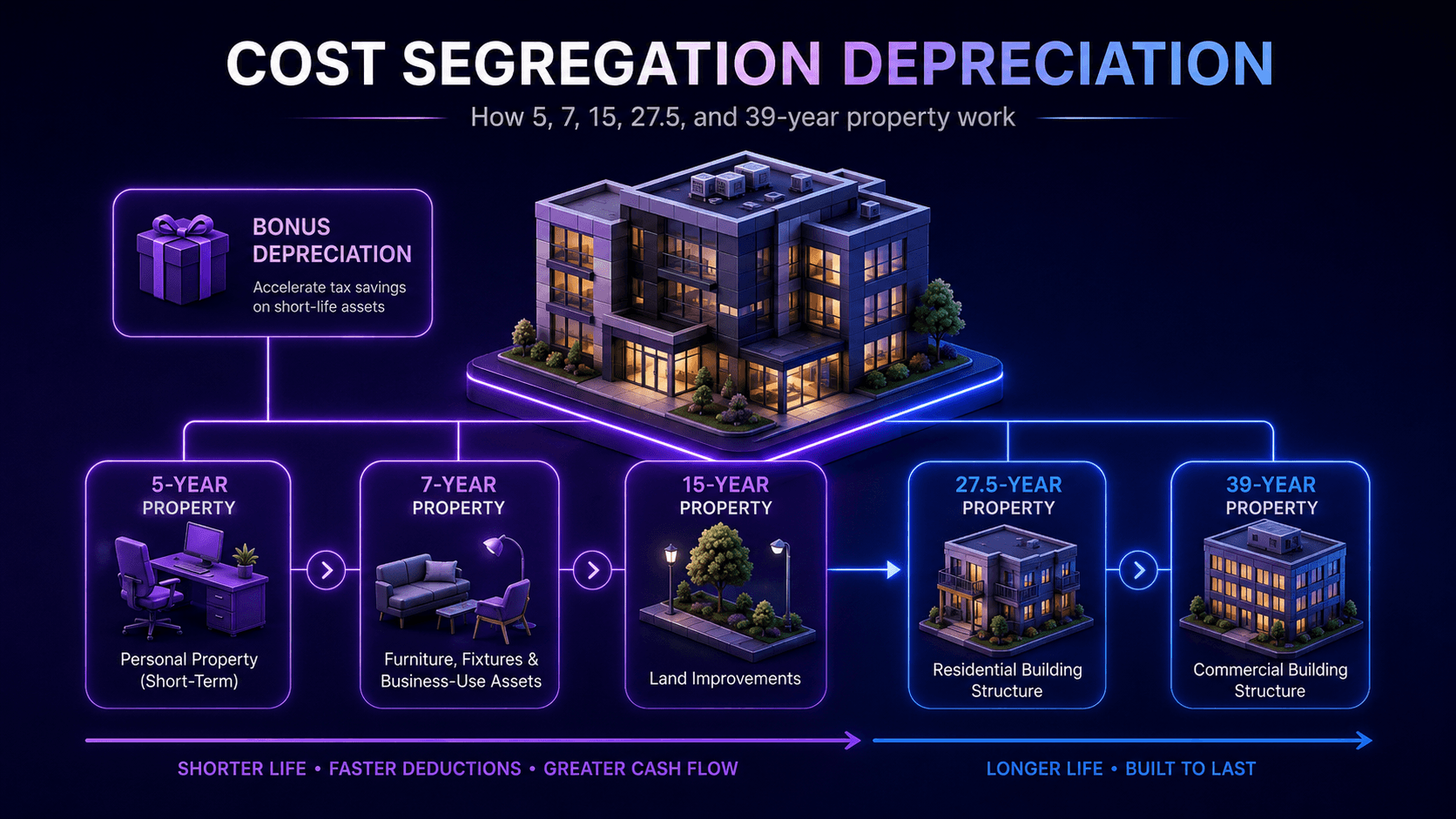

Cost segregation depreciation is primarily about timing. A building may normally be depreciated over 27.5 or 39 years, but certain components may qualify for shorter recovery periods. A cost segregation study identifies those components and helps investors claim eligible depreciation sooner.
The result can be a larger deduction earlier in the ownership period, especially when shorter-life assets qualify for bonus depreciation.
Understanding the different recovery periods helps investors see why cost segregation can have such a meaningful effect on near-term cash flow.
Depreciation Basics for Real Estate
Depreciation allows taxpayers to recover the cost of business or income-producing property over time. The applicable recovery period depends on the type of property and how it is used.
Residential rental property is generally depreciated over 27.5 years. Nonresidential real property is generally depreciated over 39 years. These longer recovery periods spread depreciation deductions over several decades.
Cost segregation changes the timing of those deductions by identifying property components that should not be treated as part of the main building structure.
The IRS provides additional guidance on depreciation methods, recovery periods, and qualifying property in Publication 946: How to Depreciate Property.
What Is Accelerated Depreciation?
Accelerated depreciation means taking eligible deductions earlier rather than spreading them evenly over the full recovery period of the building.
When a property component is classified as 5-year, 7-year, or 15-year property, the taxpayer may recover that cost faster than if it remained in the 27.5-year or 39-year building category.
This generally does not increase the total amount of depreciation available over the life of the property. Instead, it shifts deductions into earlier tax years, potentially reducing current taxable income and improving near-term cash flow.
Investors can review the benefits of cost segregation for commercial real estate for a broader explanation of how accelerated deductions may affect investment returns.
5-Year Property
Certain tangible personal property components may qualify as 5-year property.
Depending on the asset’s function and the property type, examples may include:
Certain carpeting and removable floor coverings
Furniture and fixtures
Decorative lighting
Appliances
Specialized equipment connections
Certain cabinetry and millwork
Business-specific electrical components
Some data and communication infrastructure
The key question is whether the component serves the building generally or supports a particular business, tenant, activity, or piece of equipment.
For example, a general electrical system serving the entire building will typically receive different treatment from a dedicated electrical connection installed for specialized equipment.
7-Year Property
Certain personal property may be classified as 7-year property under the Modified Accelerated Cost Recovery System, commonly called MACRS.
This category may include certain furniture, fixtures, equipment, or other tangible property that does not fall within a different recovery class.
Seven-year property is less commonly discussed than 5-year and 15-year assets in real estate cost segregation, but it may still appear depending on the property’s operations and asset mix.
A professional study should explain why each asset was assigned to a particular recovery period and include sufficient documentation for the taxpayer’s CPA to review.
15-Year Property
Land improvements are commonly associated with 15-year property.
Examples may include:
Parking lots
Sidewalks and walkways
Curbs
Fencing
Landscaping
Site lighting
Retaining walls
Certain drainage systems
Exterior signage
Recreational areas
Land itself is not depreciable. However, qualifying improvements made to the land may be depreciated separately from the building.
Qualified Improvement Property may also receive 15-year treatment when the applicable requirements are met. QIP generally relates to qualifying interior improvements made to nonresidential real property after the building was first placed in service.
Building enlargements, elevators, escalators, and internal structural framework are generally excluded from QIP treatment.
27.5-Year Property
Residential rental property is generally depreciated over 27.5 years.
This category typically includes the building structure and general systems associated with residential rental use, such as:
Foundations
Structural framing
Exterior walls
Roof systems
Permanent floors
General plumbing
General electrical systems
General HVAC
Structural stairways
Other core building components
A cost segregation study should leave these assets in the 27.5-year category when shorter treatment is not supported.
Properties commonly associated with the 27.5-year recovery period include apartment buildings, duplexes, multifamily properties, and single-family homes held for long-term rental use.
39-Year Property
Nonresidential real property is generally depreciated over 39 years.
This category commonly applies to the structural components and general building systems of:
Office buildings
Retail properties
Warehouses
Restaurants
Hotels
Medical offices
Manufacturing facilities
Self-storage facilities
Other commercial properties
Some short-term rental properties may also be classified as nonresidential property depending on how they operate and the applicable tax rules.
The classification of a short-term rental should be reviewed with a qualified CPA because the recovery period can depend on the property’s average rental period and the services provided to guests.
For more information about short-term rental studies, review the SegTax guide to Airbnb cost segregation.
How Bonus Depreciation Changes the Outcome
Bonus depreciation can significantly increase the first-year benefit of a cost segregation study.
Under current federal law, 100% bonus depreciation was restored for certain qualifying property acquired and placed in service after January 19, 2025, subject to the applicable eligibility requirements.
When a cost segregation study identifies qualifying assets with recovery periods of 20 years or less, those assets may be eligible for immediate expensing through bonus depreciation.
This may include certain:
5-year personal property
7-year personal property
15-year land improvements
Qualified Improvement Property
The building itself generally does not qualify for bonus depreciation because 27.5-year and 39-year real property exceed the applicable recovery-period limit.
Investors can learn more in the SegTax guide to bonus depreciation for rental property.
Cost Segregation Depreciation Example
Consider a commercial property with a depreciable building basis of $2,000,000.
Without a cost segregation study, most of that amount may be depreciated over 39 years.
Assume an engineering-based study identifies:
$300,000 of 5-year property
$50,000 of 7-year property
$250,000 of 15-year property
$1,400,000 of 39-year property
The study would therefore identify $600,000 of shorter-life property.
If the shorter-life assets qualify for 100% bonus depreciation, much of that $600,000 may potentially be deducted in the first year rather than recovered over 5, 7, or 15 years.
The actual tax benefit would depend on the taxpayer’s tax rate, income, passive activity status, state tax treatment, property eligibility, and ability to use the deductions.
Why Asset Classification Matters
The difference between a 5-year asset and a 39-year asset can be substantial.
However, classifications should not be based on the goal of producing the largest possible deduction. They should be based on the asset’s function, construction, use, supporting records, and applicable tax authority.
A quality cost segregation study should include:
Property-specific asset descriptions
Applicable recovery periods
Cost-allocation methodology
Depreciation schedules
Supporting photographs or documentation
Reconciliation to the property’s depreciable basis
Clear assumptions and conclusions
The IRS Cost Segregation Audit Techniques Guide emphasizes the importance of methodology and documentation when evaluating cost segregation studies. Investors can read more in the SegTax IRS audit guide to cost segregation.
Cost Segregation Versus Straight-Line Depreciation
Standard building depreciation generally spreads the building basis across 27.5 or 39 years using the applicable MACRS rules.
Cost segregation separates eligible assets from the building and places them into shorter recovery periods.
For example:
Without cost segregation
A qualifying commercial property component remains part of the 39-year building basis.
With cost segregation
The component is correctly identified as 5-year, 7-year, or 15-year property and depreciated according to that shorter recovery period.
The principal benefit is the time value of money. Receiving a deduction earlier may provide capital that can be used for renovations, debt reduction, additional acquisitions, or other business needs.
Does Cost Segregation Increase Total Depreciation?
Cost segregation generally changes the timing of depreciation rather than creating additional depreciable basis.
The total property basis remains the same. The study reallocates portions of that basis among different recovery periods.
However, the timing difference can be meaningful because a dollar of tax savings received today may be more valuable than the same dollar received many years later.
Investors should also consider the potential effects of depreciation recapture when the property is sold.
The IRS provides general information about depreciation and recapture.
Planning Considerations Before Claiming Depreciation
Accelerated depreciation is most useful when the taxpayer can use the resulting deductions or has a strategy for using them.
Important considerations may include:
Passive activity loss rules
Material participation
Real estate professional status
Current and projected taxable income
At-risk limitations
State conformity with federal bonus depreciation
Ownership structure
Planned holding period
Depreciation recapture
Future property sales
Tax-bracket changes
A large depreciation deduction may not create an immediate cash benefit if the resulting loss is suspended under the passive activity rules.
Investors should coordinate with their CPA before filing to ensure the study aligns with their broader tax strategy.
Can Cost Segregation Be Completed in a Later Year?
A study does not always need to be completed in the year the property was purchased.
Property owners may be able to complete a look-back cost segregation study for a building placed in service during a prior tax year.
Depending on the circumstances, missed depreciation may be addressed through a change in accounting method, frequently involving IRS Form 3115, rather than amending every prior return.
The appropriate filing method should be determined by the taxpayer’s CPA.
Learn more about study timing in the SegTax real estate cost segregation timing guide.
How SegTax Helps
SegTax prepares engineering-based cost segregation studies that identify eligible assets, classify depreciation categories, and provide organized reporting for CPA review.
The process includes:
Clear classification of 5-year, 7-year, 15-year, 27.5-year, and 39-year property
Property-specific engineering and cost analysis
Documentation designed to support audit readiness
A technology-enabled process for greater efficiency
Organized depreciation schedules for tax reporting
Strategic context for bonus depreciation planning
Final review by experienced cost segregation professionals
SegTax combines software-enabled analysis with expert judgment to help investors accelerate depreciation where appropriate without relying on unsupported assumptions.
Ready to Review Your Depreciation Opportunity?
Cost segregation depreciation can meaningfully improve early-year deductions, but the value depends on accurate asset classification, usable tax losses, and proper planning.
SegTax can evaluate your property, estimate the potential benefit, and prepare an engineering-based study designed for CPA application.
Request a cost segregation proposal to determine whether your property may be a good fit.
Frequently Asked Questions
What is cost segregation depreciation?
Cost segregation depreciation is the depreciation produced by separating eligible property components into shorter recovery periods through a cost segregation study.
What property can be depreciated faster?
Certain personal property, land improvements, specialized business-use assets, and qualified interior improvements may qualify for shorter recovery periods. Eligibility depends on the asset’s function, use, documentation, and applicable tax rules.
Does bonus depreciation apply to cost segregation?
Bonus depreciation may apply to qualifying shorter-life assets identified through a study. Under current federal law, certain qualified property acquired and placed in service after January 19, 2025, may qualify for 100% bonus depreciation.
Does cost segregation increase total depreciation?
Usually, no. Cost segregation generally changes when depreciation deductions are claimed rather than increasing the property’s total depreciable basis.
What is the difference between 27.5-year and 39-year property?
Residential rental property is generally depreciated over 27.5 years, while nonresidential real property is generally depreciated over 39 years.
Can short-term rentals be depreciated over 39 years?
Some short-term rentals may be treated as nonresidential property depending on their average rental period, operating structure, and services provided. The classification should be confirmed with a CPA.
Can I claim cost segregation depreciation on a property purchased in a prior year?
Potentially. A look-back study may identify missed depreciation from earlier years. A CPA can determine whether an accounting-method change or another filing approach is appropriate.
Who should review the depreciation schedule?
The taxpayer’s CPA or tax advisor should review the study and apply the depreciation schedules to the tax return.